Showing posts with label Techniques. Show all posts

One way of beating problem solving fatigue

We have all been there. We solve problem after problem, yet the big goal seems no closer than before. We get tired, even tired of success. Because right after that success, the ugly head of another problem rears itself.
I am a fan of Anthony Robbins. I am a fan because Anthony Robbins relentlessly pushes you to become better, to be successful and to achieve your goals. And he does so without being condescending and finding the best in everybody and everything. He may not get his facts right all the time but he understands that being a public figure with recorded audio and video, his mistakes stick around longer than most people. But that does not slow him down.
He taught me to think, "What is it I need to do achieve my goals" and "What needs to happen for me to achieve my goals and what can I do to make it happen". Now this temperament is also applicable to homicidal maniacs and sociopaths, so passing that through your moral code is a must. But in most cases, these ideas have helped me out when I run out of solutions or possible solutions.
The first idea is more of a wake up call. It is not so much asking you to do something, it is asking you to do anything instead of nothing. It is asking you to think up of something to do to in the pursuit of your objective. It is a call to action.
The second idea is more cerebral and goes towards thinking of what do to. It does not look only at the problem or you but also the environment. The driving idea is this: Success is possible when conditions of success is met. Once you figured that out, now what are you going to do about it. What are you going to do to change the environment so that success is possible. Changing the environment helps you focus on something than the problem directly and something that is possible to change.
Anthony Robbins is a smart man. He is even a smarter speaker. You should spend the time to listen to him.

Sometimes one of the best things to do when we are tired, is to stop and listen to someone who wants you to succeed.

Doing something bad: using Tabletop Excercise as a learning tool

We may come across the need to do something bad. Sometimes it helps to repeat our failed attempts at solving a problem. There are two likely reasons to do this. The first is to learn from our mistakes. If we can repeat safely what we did previously that didn't work, we can pinpoint what things didn't work or went wrong.
The second reason to do something we know doesn't work is to make notes on what did work and what has to be done in any solution that we choose. In another article, where I talked about how we need to learn something new when we want to do something new, I also pointed out that by finding a way to redo past processes, it becomes easier to execute a new process. Knowing what steps to repeat or things that have to be done because it affects other people, can ease us into a new process. How? It eliminates the concern that we missed something. We get to rid that feeling that we missed something.
The real problem is how can we repeat something that didn't work without making a bigger problem?

One way is use a tabletop exercise. Tabletop exercises is a favorite tool of emergency response services. First, it's cheaper than trying to replicate a full-blown catastrophe. Second, it provides a way for the leaders of organizations that have different functions and responsibilities to work together while still being responsible and in control of their own organizations.
Before we get ahead of ourselves, let's get the basics of a tabletop exercise right.
The tabletop exercise is run by a facilitator. In the context of problem solving, this is either us or the person who knows the problem. The role of the facilitator is run the exercise or scenario. We'll get to that in detail shortly. The players are other member your team or other people who are solving the problem together with you. The players will interact with each other and the facilitator as the facilitator brings the group of players through the scenarios of the problem.
It's also very useful to have an observer. This person or group is someone who is familiar with the situation or technology or mechanics of the problem but not necessarily part of your team or responsible to solve the problem. Their role is to provide an outside perspective. Observers take note of their concerns or questions but don't participate initially. Once the facilitator finishes with the scenario, the observers can ask questions and present their thoughts and ideas. The observer's role is not just to criticize but offer suggestions that the players may not have thought of during the exercise.

Overcoming the fear of Change rationally

The only constant is change. Or so we remind ourselves so often. Why? Because like it or not, at one time or the other, we all have feared change. Change is the unknown and we have a tendency to fear what we do not know. In Step5, we deal with change itself. This is simply because the solution we choose to solve our problem will undoubtedly bring out change.
I've talked about before that in order to start changing, we must first accept change. Accepting change allows us to face change without the mental weights of thinking how to resist change and finding ways to keep the status quo. I've also mentioned that sometimes we should overcome fear of change by simply being impulsive.
But let's say we learned something new but are hesitant to apply what we learned. It's there but not put to use. Like a tool that we bought but still in the packaging. The reason for this hesitation is because it is a form of fear of change. Specifically, we are unsure whether that new thing we learned is better than we already know. We wonder whether it will produce better results that what we normally do.
One way to overcome this fear is to go over the previous unsuccessful attempt. By repeating steps we've taken before, we can be sure not to miss anything. Another way is to overcome it rationally. First, we rationalize how we got to this point. Either what we were doing before wasn't working or the results we were producing wasn't good enough. So that establishes that what we need to do is something else. It's likely that we had tried what we knew but even those efforts weren't successful. So, when we exhaust what we know, all that is left if to try something new.
Second, let's rationalize the change itself by ensuring that the change is not really a total change, that we are not changing for change's sake. In fact, the best change we can do is to build on our experiences. One of the main concerns about doing something new is failing to achieve what did work before. There are two ways we can make sure when we try something new, we achieve at least some success. First, we must know what success looks like. We need to list down what that something new must achieve. We must define the goals so that whatever new things we do, it's headed in the right direction.
Second, we must also list what needs to be done other than the main goals. Even though what we did before didn't work out, it probably still did some things that were necessary. Like reports that needed to be generated along the way or measurements that needed to be taken for quality purposes. Sometimes, our previous efforts did something that was required for something else to work or necessary for another group's success. By running through what we did before and taking note of the necessary steps or things we need to produce along the way, we are ensuring the change we are achieving by doing something new still hit key targets along the way.

The Need to Ask Stupid Questions

We have all heard the phrase "there are no stupid questions". Why do people say that? More importantly when do we most likely hear someone say that? The answer to the second question is simple. People say "there is no stupid questions" during meetings when trying to get the audience to ask questions.  They also say that in group discussions when they are trying to break people's conceptions of the "stupid" and "smart" questions. Both want for it to lead to a discussion on ideas and get people to be creative. Which leads to the other often used phrase, "There are no stupid ideas".
But that is for another time. Let's look at how you can harness this to find possible solutions for your problem. This is done usually at Step3. You have admitted to having a problem and committed to finding a solution. You know what your problem is and what the goal of the solution is because you have told the group or someone else about it. Now it's time for ideas. And often you just don't have any. This is where the phrase "there are no stupid questions" comes in.
There are several ways to look at stupid questions and how they can help you find solutions. You can also use it to discount options or possible solutions to the problem later down the stage. Here are some uses for using or asking "stupid questions":

  • First - You have to ask the stupid question to get at the smart answer. Stupid questions are correctly answered by smart answers. If people give you stupid answers, don't worry because it only shows their ignorance and you know where those people stand on solving the problem. Getting a smartypants answer will also only reflect on that person, so don't get upset and move on. Keep looking for the smart answer because it is the right one. It could be the answer that everybody claims to know but reluctant to say out loud. And in a group setting, that may not be clear to everyone especially those that simply don't know. So having the smart answer being said ensures everybody understands why the question is thought of as a stupid one. Don't be surprised to find that people sometimes don't have the right answer as to the why part. 
  • Second - Stupid questions generate communication. The ability to answer a stupid question gives you an insight into that person's thinking, even if it is your own. For starters, refer to what was mentioned above about how the type of answers reflects the person answering. Secondly, an incorrect answer to a stupid question may expose a gap in understanding of the question and possibly, the problem. This would help you identify people with this different understanding. Try to understand their point of view by discussing it with them. It could just be that they are approaching the problem from another angle and from their perspective, their answers are correct. Make your case by providing clear and simple arguments to them, asking them to see things from your point of view.

Use Bad Ideas to Reach Good Ideas

When brainstorming for possible solutions, it does seems cliched to say "There is no such thing as a bad idea" or "There is no such thing as a stupid question". In both cases, it's how the idea is used or the question is answered that will determine whether some use will come out of them. You have to take the attitude that both can offer something towards solving your problem. If you are working with a group, the way to deal with latter is to have the question answered by someone who doesn't think it is a stupid question. If there is a consensus that the question is "stupid", it should be answered anyway with the person answering clarifying why they think so. Questions that have answers may lead to more questions, which spreads out the knowledge and information. Don't be surprised to find conflicting opinions when people clarify. People may disagree why a question is "stupid". Harness this to explore new ways at looking the problem. Use the difference of opinions to come out with new ones and maybe a different understanding of the problem.
There are also many uses for "bad ideas". Here are a few to start

  • Use the idea as starting point. Explain why the idea is stupid (even to yourself on paper) and then look at the opposite of those opinions.
  • Break an idea-block by using the idea and exploring it's possibilities. If it is the only idea you can come up with and you think it is a bad one, then there are probably similar ideas which may not be as bad. Continue finding ideas that are less "bad" using those similar ideas.
  • Break a deadlock between factions in a group. If the idea is something both sides can agree is not a good idea, then a common ground is created for cooperation. Work towards making sure the "bad" idea is not realized. Make the "bad" idea, the "villain" that all the factions must defeat
  • Use it as a club or disincentive. If the "bad" idea is the only one available, consider using it if no other way or a compromise is found. Consider that the only possible outcome and offer it if no alternative is found. Make the "bad" idea the Solomon decision. Don't be surprised if new ideas suddenly crop up
  • Use the idea to define the edges of reason. Create a boundary of where a discussion shouldn't go using that bad idea. But don't totally reject. Use them in the ways listed above.

Getting Unlikely Advice from Your Enemies

As I have said before in another post, the hardest problems to solve involve problems about ourselves. Personal problems are hard to solve because they are personal and close to us. We can lose objectivity. It is hard to judge ourselves because sometime we just cannot believe we are capable of doing something or believing something. But often by just changing the way we think, we can start dealing with personal problem honestly and work towards finding a solution.
An Arab philosopher once said, "If you want to know your faults, listen to your enemies". Why do you think he said that? Because our true enemies constantly look for them! We often react to negative comments with well, more negativity.  Or it could be the other way. We may have been taught to reject all forms of negativity to the point of almost denying their existence. But in reality, negativity exists. That is what I got from Newton's Law. People say bad things for all sorts of reasons. They may be jealous of our success. There are others who are not satisfied with their own success that they feel by denying others it will enhance theirs. People use negativity as way of getting attention. It is not that they themselves are negative. They are merely using negativity as a means to gain attention. They may even want to be part of what we are doing or be part of our group and it is their way of drawing attention to themselves with the hope of being included.
A good way to approach negative comments is to first listen to the negative comments. Then repeat them to people you trust. This can be a  good friend or someone who has advised you in the past. This someone should be willing to tell you the truth no matter how bad it is. If you don't have either of them, look for yourself. Ask yourself "am I so and so?" Think of ways or events that it could be true. Be honest. Nobody is listening but yourself. If so, don't beat yourself up. Everybody makes mistakes. Now that you know what they are, isn't it easier to avoid them?
If you are still not sure or feel you can't judge yourself, try this: think of what a person like that would do. Think about someone has done that bad thing or has that negative trait. Give this person a name, imagine how the person looks like. Make him real. Now image that person having that fault. Now replace that person with yourself and image you doing the same thing. Now think, have you ever done that?

Define Your Success

Let's start with this: Everybody wants something. At any given time of the day, if you think to yourself, "What do I want now?", you would probably have an answer. Most people can identify success. Success is defined by everybody in their own way. We take a look an object or observe a situation, we can come to a conclusion of whether the object or situation represents success. So success is an opinion rather than something absolute. We can identify it even better the more we desire success. A majority of us can agree to what success is and that forms a social norm. Something everybody can agree on that is good becomes something that is desirable by all.
However, as we agree with others, we tend to discredit readily other forms or opinions of what success is. We may also tend to discard our own personal ideas of success and replace them with what most people agree what success is. The agreement or argument can harden over time.We would find justifications as to why the commonly accepted view of success is best. We become more inflexible. Eventually, there is an acceptance that the way it is right now, is good enough. This over time would make the definition of success grow narrower and narrower. This would hinder solving problems. When success is narrowly defined, the options and means to achieve success and solve the problem also narrows.
But what if you disagree? What if success as defined by the majority is too limiting. What if you can see another way of defining success? You could have a solution that involves expanding the definition of success or requires an unconventional way of achieving success. Is your opinion worth any less than the majority?

Outlining Basics: Building Your First Outline

A tool I find useful in sorting out ideas and information is an outline. This is the same outline I was taught in Undergraduate English but given a slight twist. I will first cover the basics, elaborate on the components of an outline and give a simple example.
The first thing to understand about an outline is that it has a structure. It has structures on multiple levels. The first is the topmost or highest level. At this level an outline consists of 3 components.


  1. An Introduction - Normally introduces the reader to the document. Provides a basic description of the purpose and goals of the rest of the outline.
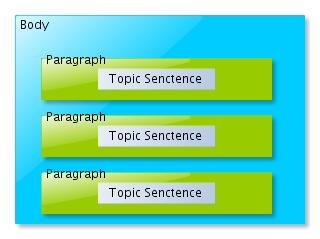
  2. A Body - Where all the main information is located, sorted and presented. In a paper or article it consists of paragraphs where each paragraph is centered around an idea or information or a collection of them.
  3. A Closing / Ending - This summarizes the document. It should re-state to a degree the purpose of the document and it's goals and how the document has achieved that. If the document is long, it should also summarize or restate key points.
The main area is of course, the body. This is the next level. The body consists of points. A point is a sentence that should state the idea in it's most simplest, straight-forward form. It can also summarize or state the topic of the information that will be elaborated on later. The elaboration can be done in the final paragraph or in sub-points. This means that points can be hierarchical or that a point can have sub-points. This is yet another level. These sub-points are points themselves and can have sub-points too. And so on and so forth.
Take a look at this simple example

  1. Introduction - Why my car won't start
  2. Body
    1. Symptom
      1. Turn the key and there is only a click-click-click sound
    2. Likley causes
      1. Battery is dead
      2. Problem with starter
  3. Closing - I need to narrow down the cause before going to the mechanic

Item '2.1 Symptom' is the topic while Item 2.1.1 is the elaboration. The sentence in item '2.2.1 Battery is dead' states the idea very simply and is a sub-point to item '2.2 Likely Causes'. Normally, there is no need to state item '2. Body' but I put it there as an guide.

When writing, these points will become a topic sentence. A paragraph is built around the topic sentence. As was pointed out earlier, the paragraphs will form the body.